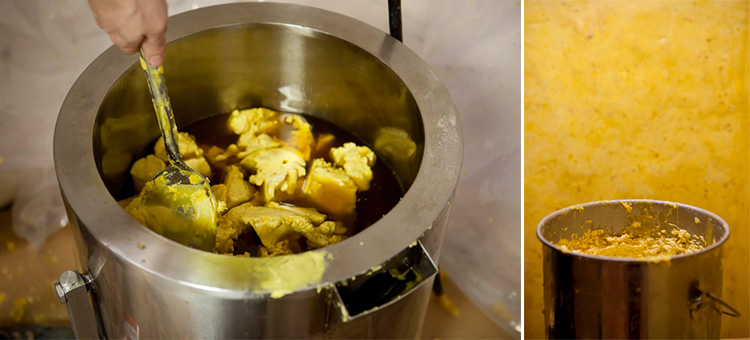
In celebration of the Laib Wax Room‘s first anniversary as a permanent installation at The Phillips Collection, Membership Associate and Marketing & Communications Intern Rhiannon Newman, who was one of four assistants in the preparation and installation, describes her experience in a four part series.
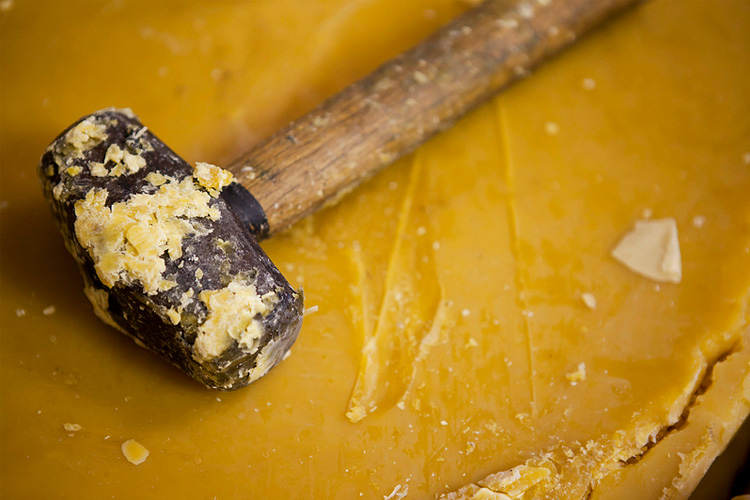
Photo: Rhiannon Newman
You would think that, with practice, breaking the wax into little bits would become easier, but in fact it still remains an awkward act. Unlike the other assistants working on the Wax Room, I am not an active individual. I am not a carpenter like Tyler nor live and work on farmland like Jeremiah. I don’t know very much about Rachel, but in the few conversations we’ve had she gives me the impression that she eats kale by the organic-hemp-farmer’s-market-totebag-full and probably has an exercise repertoire to match (Bikram yoga, or something). I once impulsively bought a set of dumbbells, intent on having biceps like Michelle Obama, but they now luxuriate in a dusty corner under the bed alongside a bacon-bowl maker and other impulse buys that didn’t work out. I am not strong. I am not used to manual labor, and maintaining hours of hammering takes a toll.
In the morning, I can maintain about an hour of consistent hammering before I start to fatigue. I try to maintain positive mental motivation to keep consistent and try a variety of methods. One go-to method is aggressive hammering, (i.e. picturing that one time my housemate came home from the gym, peeled off her socks and deposited them on the kitchen table, and channeling the anger that follows) produces some fantastic rage-induced results. Unfortunately, this furious wax block abuse leaves me exhausted a few short hours later. You’ve got to pace yourself with this stuff. Music almost works (two words: hammer drumsticks), but earbuds are isolating in an environment in which you want to be aware and present.
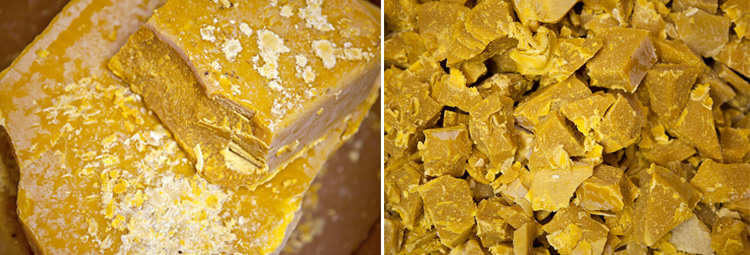
Photos: Rhiannon Newman
Despite this initial difficulty, halfway through day three I am settled in. I have a favorite hammer and I let the repetitive motion of my hands keep a beat. My favorite photography professor and advisor in college assisted Ansel Adams for a number of years. He told me a story once about an evening in the darkroom while they were packing up after a long day of printing photographs. At the last minute, Ansel decided to make one more print. As a photographer and piano player, he preferred to use a metronome instead of a timer. The metronome had been packed away, but he effortlessly moved this print through the fixer and stop bath, through his process of dodging and burning, until it was drying with the others. It looked exactly like the other prints. “That’s because he kept the beat internally,” my professor said as he gestured towards his heart. I understand. I work with my heart too, in everything I do, and that’s how I keep going.
Rhiannon Newman, Membership Associate and Marketing & Communications Intern